
CineLit: What Riveter Studio Is Building
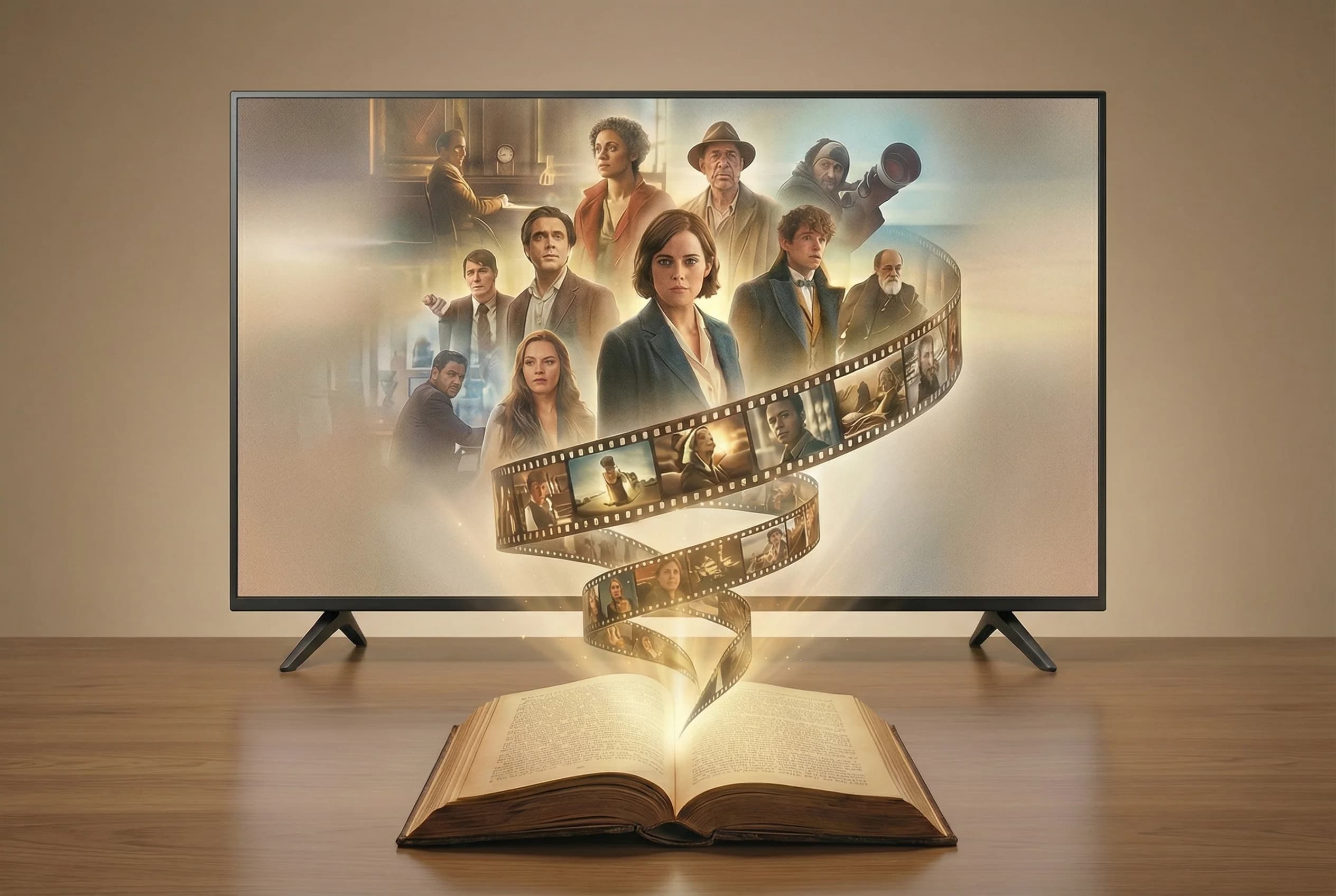
Cinema and literature have always found each other.
A novel becomes a film. A short story inspires an episode. A book written decades ago finds an entirely new readership because someone encounters the story on screen first.
That relationship isn’t new.
What is changing is who gets to participate in it—and how long they have to wait.
For most authors, the traditional path between page and screen is controlled by a long chain of people and circumstances. Someone has to discover the work. A producer has to see potential in it. Rights have to move. Financing has to come together. And even then, only a tiny fraction of published work ever makes that journey.
Riveter Studio began with a different question:
What if authors and stories didn’t have to wait for the traditional machinery of film and publishing before they could benefit from cinematic storytelling?
That’s the idea behind CineLit.
What do we mean by CineLit?
At its simplest, CineLit is the space where literature and cinematic storytelling meet.
We are not talking about replacing books with video, and we are certainly not suggesting that every book needs to become a movie.
We are talking about giving readers another way to discover literature.
Someone may first encounter an author through an interview. Another person may see a cinematic scene from a story and become curious about the larger work. Someone else may come across a short piece on social media, follow it to a longer conversation, and eventually find the book.
Each experience creates a different entry point.
The page remains the source.
The screen becomes another doorway.
Why does that matter now?
Because one of the biggest challenges facing authors today isn’t necessarily the quality of their work.
It’s getting anyone to stop long enough to notice it.
Authors are not only competing with other books for attention. They’re competing with streaming television, podcasts, social media, newsletters, games, news, and an almost limitless amount of material arriving on our screens every day.
A very good book can disappear in that environment.
We’ve seen this repeatedly in our work with authors. They may have spent years developing their craft and building a substantial body of work. Many have interesting careers, extraordinary research stories, unusual experiences, or very clear ideas about why they write what they write.
Yet much of that remains invisible to someone encountering a thumbnail of their book for the first time.
CineLit gives us more material to work with than the cover and the sales description alone.
The author is part of the story
One of the clearest lessons from producing author interviews is how much interesting material exists around the book.
Why this story?
Where did the idea come from?
What happened during the research?
Why did a particular character refuse to leave the author alone?
What changed between the first draft and the finished book?
What has writing twenty books taught someone that writing the first one couldn’t?
Those answers are not simply promotional copy. They tell us something about the person who created the work.
That thinking led to Authors in Focus, our author interview process built around three parts: The Author, The Journey, and The Craft.
The Author introduces the person and their work. The Journey explores what brought the book or body of work into existence. The Craft goes deeper into the writer’s process.
Together, those conversations allow someone to do something that a standard biography rarely accomplishes.
They let the reader get acquainted with the author.
That matters because sometimes interest in the person becomes the reason someone takes a closer look at the book.
Then there is the story itself
Some writing contains moments that almost ask to be seen.
A scene has movement. There is tension. Something turns. A character makes a choice. The setting contributes to the experience. The scene has enough shape that it can stand on its own while still making us curious about the larger story.
That is the thinking behind Stories in Motion.
We select stories and scenes that already contain cinematic possibilities and explore how they can live visually without trying to turn the entire book into a conventional adaptation.
That distinction is important to us.
The objective isn’t to take possession of an author’s work and rewrite it into something more “filmable.” We start by asking what is already there.
What can be shown?
What is happening between the characters?
What gives the scene its rhythm?
What should remain exactly as the author wrote it?
The writing comes first.
The screen serves the story.
This isn’t a book trailer
A traditional book trailer generally has a straightforward job: promote the book.
CineLit can do something different.
Instead of describing the story, we can let an audience experience a piece of it.
Instead of telling people that an author is interesting, we can let them hear that author speak.
Instead of trying to compress an entire novel into a promotional summary, we can concentrate on one character, one encounter, one question, or one moment.
That creates a different relationship with the audience.
The message is no longer simply:
Buy this book.
It can become:
Come inside for a few minutes.
Curiosity does some of the work.
We’re not trying to solve a content shortage
There is already more content than anyone can reasonably consume.
Producing more of it is not, by itself, an accomplishment.
What interests us is creating pieces that have a reason to exist beyond filling a posting schedule.
An author interview should be useful in more than one place. A cinematic scene should lead somewhere. A shorter social piece should have something deeper behind it for the person who wants to continue.
The individual pieces begin to matter more when they connect.
An interview introduces an author.
The author leads to a book.
A cinematic scene introduces part of a story.
The story leads back to the larger work.
A shorter piece can lead to a longer conversation.
Instead of treating every asset as an isolated post, we begin building pathways through the author’s work.
That idea has become increasingly central to how we think about Riveter Studio.
Build the important thing first
There is another practical side to this.
Authors are already being told they need an endless supply of content.
We don’t think the answer is necessarily to create more things from scratch.
Start with something worth making.
A thoughtful author conversation can become a full interview, shorter excerpts, individual answers, quotes, website material, press assets, and social posts.
A strong cinematic scene can create its own shorter discovery pieces.
The source material has depth, so the pieces that come from it have somewhere to lead.
That is very different from sitting down every morning and asking, “What am I supposed to post today?”
Create the important thing first.
Then let it work harder.
Technology has changed what is possible
Some of what we’re building would have been prohibitively expensive for independent authors and small publishers not very long ago.
Production tools have changed rapidly. Editing, visual effects, animation, image creation, sound, and other parts of filmmaking can now be accomplished differently and, in many cases, much more efficiently.
That opens doors.
But it also creates a new problem.
The ability to make something does not automatically make it worth making.
Technology can help us produce. It cannot decide what matters.
It cannot determine which author has something worth hearing, which scene has enough strength to stand on its own, what part of the writing should remain untouched, or whether a piece actually gives someone a reason to care.
Those are editorial decisions.
Human judgment remains at the center of our process.
The technology expands what we can do with that judgment.
Why call it CineLit?
Because neither “video production” nor “book marketing” quite describes what we’re trying to build.
Our starting point is literature.
But we work with many of the tools and disciplines of film: interviewing, storytelling, editing, sound, image, performance, pacing, and visual narrative.
Sometimes the author is the subject.
Sometimes the story is.
Both belong to the same larger idea.
CineLit gives us a useful name for that intersection.
It also gives us room to explore where that intersection can go next.
What is Riveter Studio building?
We are building a connected body of work around authors and stories.
That includes Authors in Focus, where readers meet the people behind the books.
It includes Stories in Motion, where selected literary scenes can be experienced cinematically.
It includes educational resources that help authors understand how to use these tools themselves.
And increasingly, it means thinking about how those pieces connect rather than treating each one as an individual product.
An author should not disappear when an interview ends.
A story should not become disposable because someone has watched one scene.
A viewer should have somewhere meaningful to go next.
The more those pathways connect, the more interesting CineLit becomes.
The page isn’t going anywhere
Neither should it.
Riveter Studio was built by people who care about books.
CineLit does not begin with the assumption that readers have stopped reading or that literature needs to become video in order to remain relevant.
It begins with a much simpler idea.
Good writing deserves more ways to be discovered.
Film and literature have been introducing audiences to one another for more than a century. The difference is that authors no longer necessarily have to wait for Hollywood to decide their work is worth putting on a screen.
That distance can be shorter now.
And that’s what we’re interested in building.
Cinema and literature have always found each other. Riveter Studio cuts down the waiting time.
Enjoyed this post? Get new ones the moment they publish.
Sign up for updates